


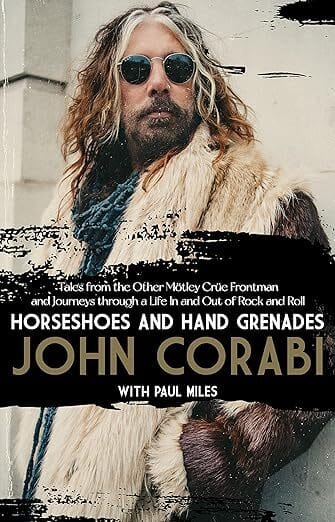
John Corabi — Horseshoes and Hand Grenades
John Corabi’s autobiography Horseshoes and Hand Grenades was released in 2022. It had long been on my “to-be-read” list, but I never purchased a physical copy. It wasn’t until Corabi—also known as Crabby—completed his solo debut album, scheduled for an April 2026 street date, that I decided it was finally time to read the book.
Corabi is considered a musical journeyman, but more than that, he oozes talent. He is best known as the vocalist who replaced Vince Neil in Mötley Crüe for several years in the mid-1990s. He is the voice on the band’s 1994 self-titled album, Mötley Crüe, an album many hard-rock fans—including yours truly—consider to be the band’s best.
I knew going in that I would make a personal connection to the book, and that happened more than once.
Prior to joining Mötley Crüe, Corabi fronted a band called The Scream, which released one album in 1991 through Hollywood Records. It’s a mighty fine album that never received the recognition it deserved. This is where the personal connection comes in.
The drummer for The Scream was Walt Woodard III. Before joining the band, Walt gigged with Sweet Savage, a group that was on the cusp of landing that elusive record deal but never quite got over the hump.
Whenever he was in town, I would spend time chatting and hanging out with Walt at shows. He was always a stand-up guy and a laid-back dude, simply put.
Corabi’s book provided insight into his time with The Scream, including stories involving Walt. It was nice to read those memories, though also a bit disheartening at times. I saw Corabi perform an acoustic set in 2021, prior to the book’s release, and had the opportunity to speak with him. I asked specifically about Walt and what had happened, which gave me a bit of closure alongside the stories shared in the book.
Corabi also wrote about a Dallas show in June 1994 that I attended and the fallout surrounding that performance, including an incident during a live on-air promotion with a local rock station. I remember all of it vividly.
I will admit I was a bit bummed he didn’t mention Type O Negative’s final night on the tour, when the support act pranked the headliner instead of the other way around. I was there and documented it on slide film. Afterward, Type O Negative bassist and vocalist Peter Steele said, “Nobody sees those pictures.” I’ve kept my word, even though I could have earned a nice payday from those images.
Beyond these personal connections, Horseshoes and Hand Grenades is simply a great read. Life isn’t always rosy, and Corabi illustrates that honestly throughout the book.
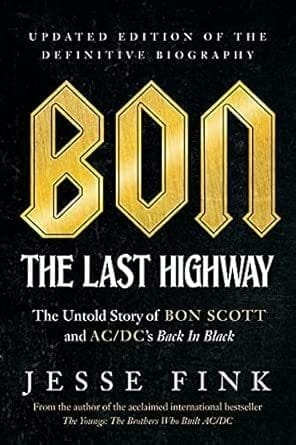
Bon: The Last Highway — Jesse Fink
There’s no denying that AC/DC’s Back in Black, released in the summer of 1980, is an extraordinary album and marked the band’s ascent to legendary status. The record was also the band’s return after tragically losing vocalist Bon Scott following a night out. The coroner’s report listed the cause of death as “acute alcohol poisoning” and classified it as “death by misadventure,” though some believe there may be more to the story.
Before Back in Black, AC/DC released four strong studio albums and one live album in North America: High Voltage, Let There Be Rock, Powerage, Highway to Hell, and the live album If You Want Blood You’ve Got It. All featured Bon Scott on vocals. The band was clearly on the rise, and Highway to Hell was breaking through commercially when Scott’s fatal night occurred in February 1980.
It’s worth noting that Atlantic Records released Dirty Deeds Done Dirt Cheap (1976) in the United States in April 1981 during the Back in Black boom. Later came the ’74 Jailbreak EP, a collection of earlier recordings featuring Scott, released in 1984.
Fink’s book takes a deeply investigative look at Bon Scott’s final night. It’s extremely well written and packed with informative interviews. I hadn’t realized the extent to which UFO factored into Scott’s story.
I also learned that AC/DC’s first U.S. show took place in Austin and that the night before the Texas World Music Festival—better known as Texxas Jam—in 1978, AC/DC performed a warm-up festival show at the coliseum adjacent to the iconic Cotton Bowl in Dallas. I even found myself heading to YouTube to watch clips mentioned in the book.
Whatever truly happened that night, the book paints a picture of Scott as an extraordinary person. Friends meant everything to him, and he regularly sent postcards, Christmas cards, and handwritten notes to those he cared about.
Over the years, Bon Scott has attained legendary status as both a vocalist and lyrical genius—recognition that sadly grew only after his passing. Many hard-rock fans still prefer the Bon Scott era of AC/DC. Brian Johnson, Scott’s successor, has done an incredible job fronting the band, particularly on Back in Black.
That said, there’s something uniquely special about the Bon Scott era, and Bon: The Last Highway will leave readers even more curious about the wild Scot from Scotland.

Malcolm Young: The Man Who Made AC/DC — Jeff Apter
If not for Malcolm Young and his relentless drive, there would be no AC/DC. Malcolm was essentially the brain behind the band, instilling a powerful work ethic in every member. While Angus Young is the younger brother and visual focal point, Malcolm was unquestionably the band’s captain.
The Young family migrated from Scotland to Australia in 1963 under the Ten Pound Pom program. I had often wondered how Scotland influenced AC/DC’s identity despite the band’s Australian roots. This book explains that connection thoroughly and highlights the workhorse mentality that defined the band’s rise. Malcolm led the charge, with Angus close beside him.
The chapters detailing Malcolm’s decline are heartbreaking, but it’s the opening passage that truly hooks the reader.
While researching the book near the assisted-living facility where Malcolm resided, the author spotted a small man with long hair and a beanie slowly shuffling along during a guided walk. It was Malcolm—the legendary rhythm guitarist—physically present but mentally distant as dementia had taken hold.
After finishing the book, I gained an even deeper respect for both the band and the quiet figure who remained anchored in his square position to the right of the drum riser, standing before his Marshall cabinets.

Mark Evans — Dirty Deeds: My Life Inside and Outside AC/DC
Mark Evans served as bassist on AC/DC’s early albums, including T.N.T. (1975), High Voltage (1976, international version), Dirty Deeds Done Dirt Cheap (1976), Let There Be Rock (1977), and ’74 Jailbreak (1984).
Evans was replaced by Cliff Williams in 1977, who remained with the band until his retirement in 2016.
In his autobiography, Evans recounts the band’s early days, the relentless touring schedule, and the devastation he felt after being dismissed in 1977. The band believed they needed a bassist with more experience who could also provide backing vocals.
There are plenty of entertaining stories from those formative years, but one theme becomes clear: Malcolm Young was the guiding force behind AC/DC’s eat-live-and-breathe mindset. That relentless philosophy is a major reason the band holds such a permanent place in rock history.


Discussion