

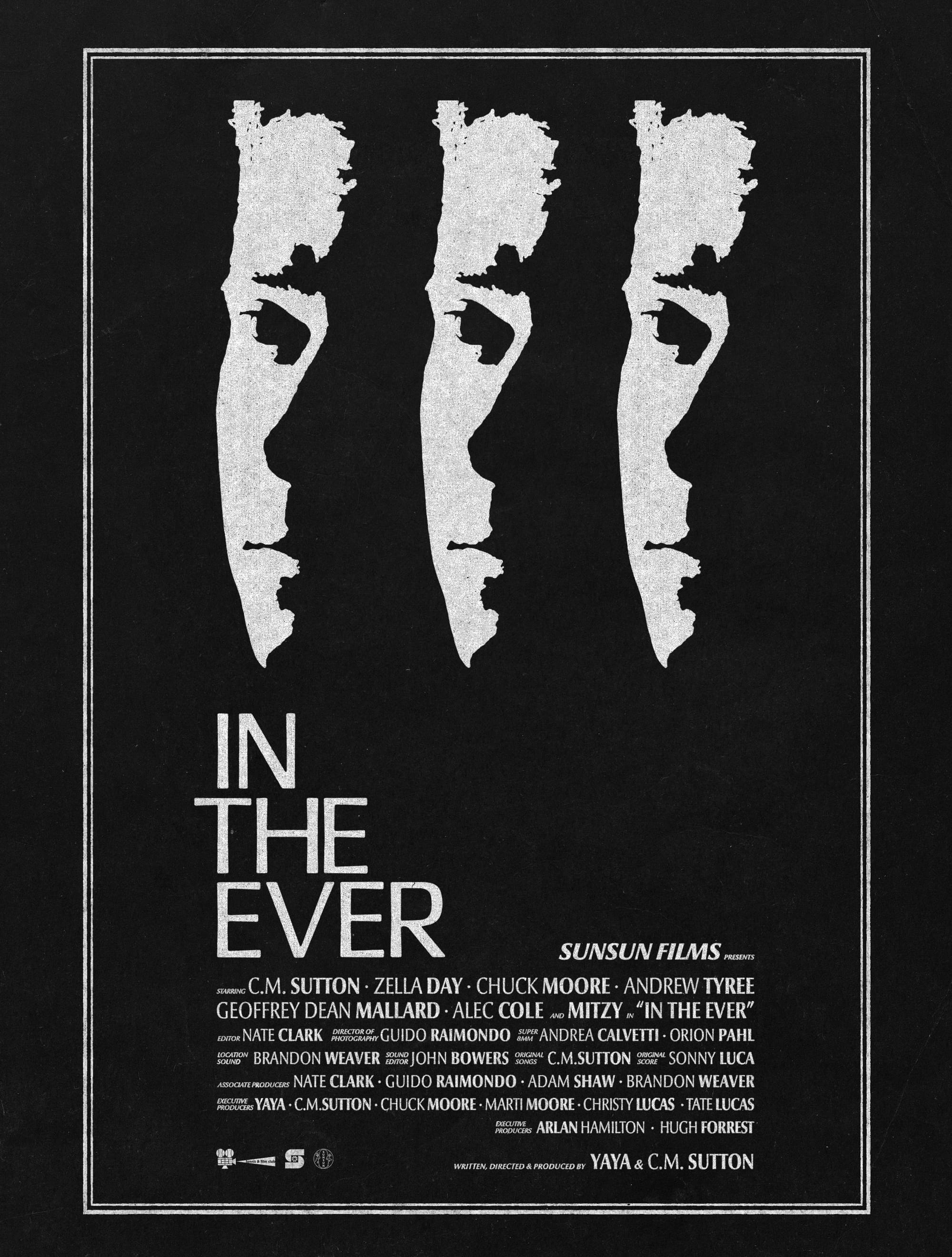
Making its world premiere at the Cleveland International Film Festival, In the Ever is a gut-punch of a debut—five years in the making, across two states, held together by a small crew and an even bigger sense of emotional intention. The film plays like a love letter reconstructed from fractured memories: that of 1970s folk singer Sam Ellis, a man who becomes a star almost overnight and immediately starts to come undone.
His rise is built on songs written for his late mother—composed at a remote desert ranch and penned by C.M. Sutton, who also stars as Sam and co-directs the film. The fame hits fast, but Sam can’t hold it. Or maybe he was never supposed to. Either way, watching him fracture under the weight of being seen feels less like character study and more like emotional autopsy.
I won’t spoil the film’s major twist, but when it hits, it’s gut wrenching. And C.M. Sutton’s performance in that moment quietly reframes everything you thought you understood about Sam up to that point.
After eight months of isolation—and a suicide attempt—Sam returns to the desert ranch, a place that feels less like home and more like a memory he can’t stop reopening. There, he meets Lee, the wife of the ranch’s owner. Their connection is subtle, complicated, and increasingly hard to define in any clean way. Lee is played by Zella Day, who absolutely holds her own in her first feature film role. If you were a teen in 2015, you probably knew her from East of Eden or Hypnotic—and seeing her here, stripped into something quieter and more grounded, is genuinely striking.
What In the Ever does so well is world-building without ever showing off about it. 1972 doesn’t feel recreated—it feels remembered. Every detail is intentional, from the dusty stillness of the desert to something as oddly specific as a box of Mini-Wheats sitting on top of a fridge. Nothing calls attention to itself, which is exactly why it all lands.
Seeing it premiere at CIFF made that immersion even sharper. There’s something about a festival audience—people sitting in the dark with a film they’ve never seen before, collectively holding their breath—that makes a story like this feel alive in a different way. It doesn’t just play on screen. It sits with you.
As the filmmakers Yaya and C.M. Sutton describe it:
“IN THE EVER explores our shared sense that sadness clings to our lives until we do something with it — whether we want it to or not, whether we share it with people or keep it silent. In all cases, we survive with beauty and imperfect resilience.”
That idea doesn’t just stay in the film—it spills into the conversation around it. In the post-screening Q&A, actor Chuck Moore (who plays Larry and is also Yaya’s father) talked about something that lingers long after the credits: how much we ask of celebrities, and how easily we turn real people into something consumable. The timing of that conversation, right after watching Sam unravel on screen, made the question feel uncomfortably immediate.
At its core, In the Ever is about grief that doesn’t resolve itself neatly. It’s about longing that doesn’t know where to go. And it’s about music as both survival tool and self-destruction loop. Sonny Luca’s score elevates every emotional turn, but it’s the songs Sam performs—songs born out of loss—that carry the heaviest weight. Watching him return to them night after night starts to feel less like performance and more like reopening a wound for an audience that keeps asking to see inside.
And maybe that’s the point.
Because by the time In the Ever ends, you’re left with a question that doesn’t leave quietly: what does it cost to turn your pain into something people applaud for—and how long can anyone survive that exchange?


Discussion