

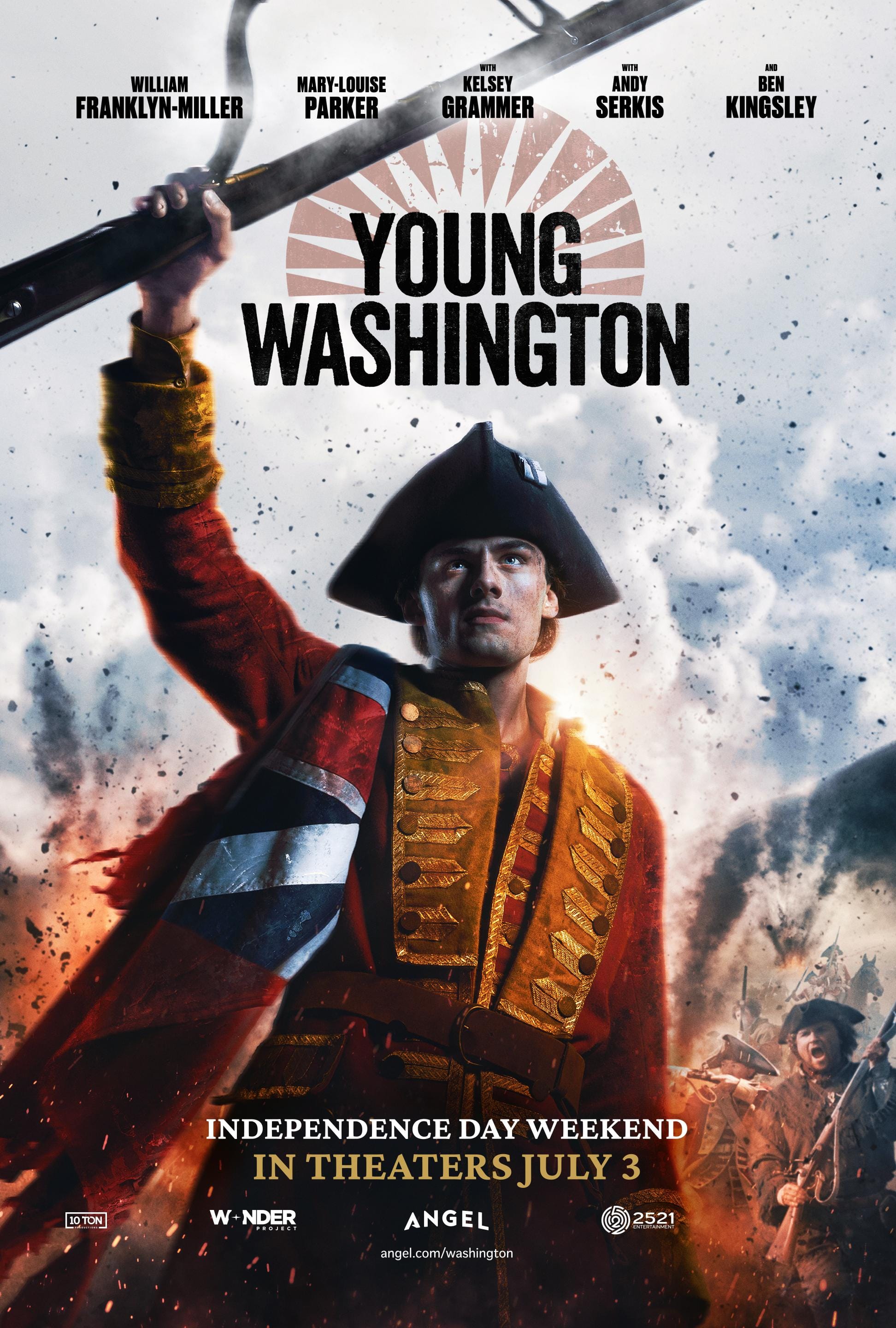
In theory, Young Washington is the story of, well... a young George Washington.
What I actually watched was a two-and-a-half-hour America 250 propaganda film about the French and Indian War that also happens to be another example of Hollywood's growing obsession with generative AI.
Now listen. I didn't go into this with high hopes.
It was the Fourth of July weekend. We were in the middle of an absolutely miserable heat wave. The movie theater had air conditioning, and my mom wanted to see it. Sometimes that's enough of a reason to buy a ticket.
I knew this wasn't going to be a brutally honest retelling of George Washington's life. If anything, I expected a heavily sanitized, patriotic version of America's first president. That's pretty much what I got.
And honestly? If you completely disconnect the movie from real history and look at it as a fictional coming-of-age story, it's... fine.
The central theme—"Even a pawn can take a king"—serves as Washington's guiding philosophy throughout the film. It's a simple idea, but it works well enough. It gives the movie a clear emotional throughline and turns Washington into the classic underdog hero learning how to become a leader.
It's not exactly original, but then again, originality hasn't exactly been Hollywood's strong suit lately.
The problem starts when the movie wants you to believe it's saying something meaningful about history.
If you're looking for historical accuracy, this isn't it.
The film spends two and a half hours mythologizing George Washington while barely acknowledging the uglier realities of the time. Slavery is mentioned just enough that the filmmakers can say they addressed it, but the enslaved characters are barely given any dialogue or development. Then the film expects the audience to feel emotionally invested when one of them dies in battle.
That's not how storytelling works.
You don't earn emotional payoff by introducing characters five minutes before asking us to mourn them.
But honestly, historical accuracy wasn't even my biggest issue.
My biggest issue was the use of AI.
While I was sitting in that wonderfully air-conditioned theater hiding from another day of oppressive heat and humidity, I couldn't stop thinking about the irony. The planet is literally getting hotter every year, conversations about climate change are impossible to ignore, and yet the entertainment industry continues racing toward generative AI despite the environmental concerns surrounding the technology and the ongoing debate over how many of these models were trained using artists' work without permission.
Then I learned how Young Washington actually used it.
Director Jon Erwin has openly discussed using generative AI in roughly 100 shots throughout the film. According to Erwin, AI was used to expand environments, create additional visual effects like cannon fire, extend the icy river sequence after filming actors safely in a controlled water tank, and even transform footage of crew members in modern clothes into British soldiers on horseback for scenes they hadn't originally captured. The production also employed dedicated AI artists alongside the visual effects team.
Erwin has defended the decision by saying AI made the production safer and more affordable.
I completely agree with keeping actors safe.
Nobody needs performers risking hypothermia for the sake of authenticity.
But filmmaking has spent decades developing practical effects, stunt work, miniatures, matte paintings, and visual effects artists whose entire careers are built around solving these exact problems. Choosing generative AI instead doesn't exist in a vacuum. It raises legitimate ethical questions about replacing creative labor, normalizing technology trained on artists' work, and increasing the environmental footprint of an industry that's already resource-intensive.
For a movie celebrating American history, it feels like an odd hill to plant a flag on.
Which brings me to my biggest question.
Why is this movie about the French and Indian War?
Seriously.
This was produced as part of the America 250 celebration, commemorating the 250th anniversary of the United States. So why spend all this time on the conflict that happened before the American Revolution?
It's a bizarre creative decision.
If your goal is introducing younger audiences to George Washington, I understand starting with his military career. But somewhere along the way, the movie loses sight of what it's actually trying to celebrate.
It’s something that kept nagging at me the entire time I was watching this.
This movie desperately wants you to feel patriotic. Every speech, every swelling musical cue, every triumphant moment is designed to make you leave the theater feeling inspired by America's founding.
The problem is... that's a hard sell in 2026.
It's difficult to lose yourself in a celebration of America's ideals when every day seems to bring another horrific tragedy, another headline that makes you question where we're headed, or another political decision that feels completely at odds with the principles our leaders claim to uphold. Whether it's attacks on civil rights, growing political division, or the seemingly endless cycle of violence dominating the news, it's hard to watch a movie celebrating the birth of the nation without thinking about where that nation is today.
I couldn't help wondering what the Founding Fathers themselves would think of the country we've become. They certainly weren't perfect—far from it—but it's hard to imagine they envisioned a future where so many Americans feel exhausted, angry, and disillusioned with the state of our democracy.
Maybe that's why the movie never landed for me.
Patriotism isn't something a film can manufacture with stirring speeches and heroic music. It has to connect with the moment we're living in. And right now, asking audiences to ignore the realities outside the theater for two and a half hours feels less inspiring than disconnected.
That's a shame because there are genuinely talented people here.
The cast does an admirable job with the material they're given. Several performances elevate scenes that would otherwise fall completely flat, and I found myself wishing they'd been handed a stronger script and a movie that trusted them more than digital shortcuts and patriotic speeches.
Then the credits rolled.
And right in the middle of them, the movie asked me for a donation.
I'm sorry... what?
You just spent two and a half hours selling me a mythologized version of George Washington, showcased generative AI as part of the filmmaking process, and now you're asking me to give you more money?
Absolutely not.
At the end of the day, Young Washington isn't the worst movie I've ever seen. There are flashes of a decent coming-of-age story buried underneath the patriotism. The cast deserves credit, and the central "pawn to king" metaphor works better than I expected.
But none of that outweighs the bigger picture.
Hollywood keeps asking audiences to embrace generative AI as just another filmmaking tool. Young Washington is one more example of that trend, and I don't think it's a direction worth celebrating.
Artists deserve better.
Audiences deserve better.
And frankly, so does the planet.
TL;DR: If you want a fictional coming-of-age story about George Washington, you might find something to enjoy here. If you're looking for historical accuracy, meaningful storytelling, or another reason to trust Hollywood's embrace of generative AI, you'll probably leave as frustrated as I did.


Discussion